FinTech Walk & Talk: The Bonds Edition with Indrė Dargytė
We talked about how bonds work, why investors should understand what happens when a company cannot repay its debt, the difference between automation and artificial intelligence, the future of European digital identity, financial literacy and the mistakes founders make when they fall in love with their own products.

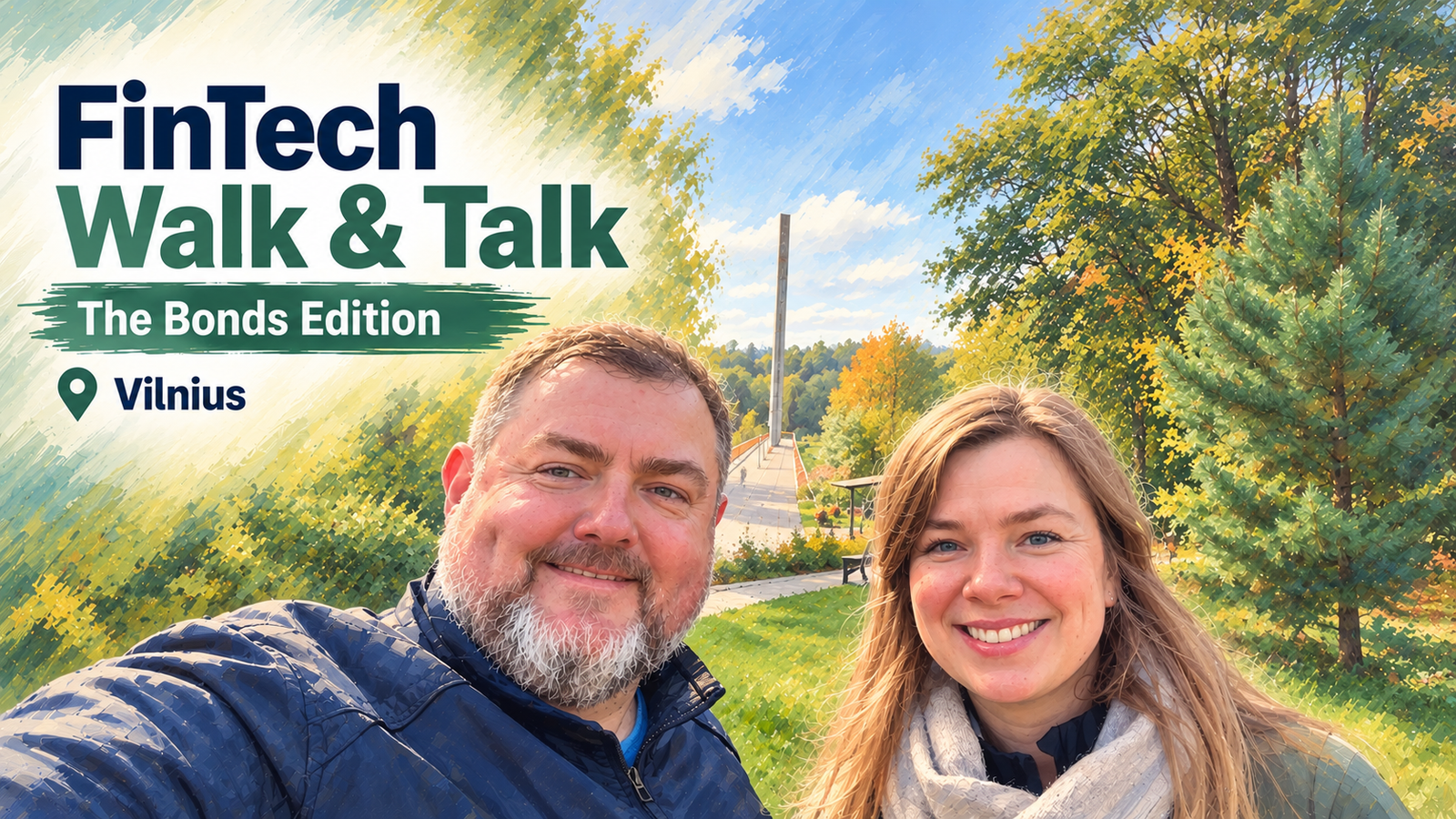
Author: Aleksejus Loskutovas
Originally published: LinkedIn Newsletter #FinTechWalkAndTalk.
Some FinTech conversations happen spontaneously. Others take a little more patience.
My walk with Indrė Dargytė was definitely the second kind.
We had agreed to meet quite some time ago. But somehow, something always got in the way. But finally, on a beautiful, sunny Wednesday, everything worked out.
We met in Vilnius, grabbed a coffee and headed towards Žvėrynas for our long-awaited FinTech Walk & Talk.
My guest was Indrė Dargytė, the founder of BeMyBond, a Lithuanian FinTech platform making bond investments more accessible to retail investors.
Indrė has spent almost two decades in finance, including nearly 10 years in London, working across capital markets, asset management and financial instruments.
What I found particularly interesting was that her business idea didn't come from a typical startup brainstorming session.
It came from years of dealing with a financial process that was unnecessarily complicated.
We talked about how bonds work, why investors should understand what happens when a company cannot repay its debt, the difference between automation and artificial intelligence, the future of European digital identity, financial literacy and the mistakes founders make when they fall in love with their own products.
And, as usual, we went well beyond FinTech.
Here's our conversation.
From London to Lithuanian FinTech
Aleksejus: Indre, welcome to FinTech Walk & Talk! I traditionally start with a simple question: how did you end up in FinTech?
Some young people believe you need the right connections, a very specific education or a carefully planned career. What was your journey?
Indrė: My journey started in finance rather than FinTech.
I studied in London, and during my university years I have had the opportunity to complete summer internships in different areas of the financial industry. I was exposed to equity trading, debt issuance and other financial instruments.
It was a very interesting time to enter the industry, especially because the global financial crisis arrived just as I was starting my career. I spent almost ten years working in London before returning to Lithuania.
Later, I was involved in different financial transactions, including bond issuance. I wasn't just observing the process - I was organising it myself.
And I could see how inefficient it was.
Aleksejus: What exactly was so inefficient?
Indrė: Almost everything, from both sides. For companies issuing bonds, the process involved a lot of documentation, intermediaries and administrative work. For investors, it was even more complicated.
At that time, if you wanted to invest in bonds, you often had to physically visit a bank branch. To open a securities account, you first needed a current account with the bank.
And to open that account, you had to come in person.
Imagine doing all that during the COVID period.
Aleksejus: So COVID helped accelerate digitalisation, but the investment process itself was still rather old-fashioned?
Indrė: Exactly. Electronic signatures and remote identification gradually made things easier, but the overall bond issuance and investment process remained bureaucratic.
Then the European crowdfunding regulation created new possibilities. It became possible to distribute certain securities, including bonds, through regulated crowdfunding platforms.
And I started thinking:
Why not use this framework to make the whole process much simpler?
Not only for companies raising capital, but also for smaller investors who previously had limited access to these opportunities.
Aleksejus: So you had practical experience with the traditional process, saw how complicated it was, and when regulation changed, you realised there was an opportunity to do things differently.
Indrė: That's a good summary.
How BeMyBond was born
Aleksejus: Let's talk about BeMyBond. How did the idea actually become a business?
Indrė: Around 2022, I was deeply involved in investment funds management. Together with my colleagues, we had developed a real estate investment fund management business. It was very intense operational work.
At some point, I realised that I needed to step away from everyday activities and think about what I wanted to build next.
There was also another aspect. The funds we managed were generally accessible to investors who could invest at least €125,000.
That's a significant entry barrier. And if you want proper diversification, you need considerably more capital because you shouldn't put all your money into one fund.
I started thinking that it wasn't entirely fair that smaller investors couldn't access interesting investment opportunities simply because they didn't have enough capital.
At the same time, I was studying the new European crowdfunding regulation. And those two things came together.
Aleksejus: I have to ask something. How many pages was that regulation?
Indrė: I don't remember the exact number, but actually, I would say it was one of the better-written regulatory documents.
Aleksejus: That's probably not something we hear very often about European regulation.
Indrė: True! But in this case, it created real opportunities. Lithuania had already been among the early countries to regulate crowdfunding nationally. The European framework helped harmonise the rules and opened the possibility of developing these services more broadly.
For me, the interesting part was combining that regulation with a digital platform and a financial instrument I already understood very well.
Aleksejus: And that's how BeMyBond appeared.
Indrė: Yes. We wanted to make bond investing more accessible while preserving the proper legal structure, investor protections and credit-risk assessment. Not simply create another website where people transfer money.
Bonds explained without complicated financial terminology
Aleksejus: Let's imagine that some of our readers have never invested in bonds. Can you explain, in simple terms, what BeMyBond actually does?
Indrė: We bring together investors who want to invest smaller amounts, starting from €1,000, and companies that want to raise capital by issuing bonds.
A company might need financing for expansion, working capital, purchasing assets or developing a real estate project. Instead of borrowing from one institution, it raises funds from multiple investors. Those investors purchase bonds, which represent the company's debt obligations. The company agrees to pay interest and repay the principal according to the terms of the bond issue.
Aleksejus: And what are the typical investment amounts and maturities?
Indrė: Our average investment is around €5,000, although people can start with €1,000.
Most of our bond issues have maturities of up to two years, and recently we've seen a preference for somewhat shorter periods, around 18 months. I think geopolitical uncertainty is one reason. Investors don't necessarily want to lock up their capital for a long time.
Under the crowdfunding framework, there is also a €5 million fundraising threshold per project owner over 12 months.
Aleksejus: Let's make this even more practical. I register on your platform, invest my last €3,000 into a project, and click the confirmation button. What happens to my money?
Indrė: First, we collect the investments from different investors. The money isn't immediately transferred to the company. There are several conditions that need to be fulfilled, including the registration of the bonds in the relevant securities accounts.
This is important because there must be independent evidence that you actually own those securities. Only when the documentation and registration processes are completed do we release the funds to the issuer.
Aleksejus: And when do I start earning interest? From the moment I transfer my money?
Indrė: Not immediately. There is a fundraising period, followed by the regulatory reflection period and the securities registration process. Interest starts accruing when the transaction is completed and the funds are transferred to the issuer.
Depending on when you invest during the fundraising period, the whole process might take around one to two weeks.
Aleksejus: And how do I receive the interest?
Indrė: Our projects generally pay interest every six months. For example, if a bond offers an 8% annual coupon, you would receive approximately 4% of the principal every six months, assuming the issuer pays as agreed.
The payment goes into your electronic wallet on the platform. You can withdraw it to your bank account or reinvest it. At maturity, the issuer repays the principal together with any remaining accrued interest. Some issuers also have the right to redeem bonds early.
Aleksejus: So if the company repays after one year instead of two, I don't receive interest for the second year?
Indrė: Correct. Interest is calculated for the period during which the money was actually borrowed, according to the bond terms.
The question every investor should ask: what if the company doesn't repay?
Aleksejus: Now comes my favourite question. Everything sounds wonderful. The investor receives interest, the company receives financing, everyone is happy. But what happens if the company doesn't repay?
Indrė: That's where the structure of a bond becomes particularly important. Unlike a simple loan agreement, a bond issue involves additional legal mechanisms. One of them is the bondholders' trustee.
This is an independent party representing the interests of bondholders, particularly when something goes wrong. If the issuer breaches its obligations, misses an interest payment or fails to repay the principal, the trustee can coordinate actions on behalf of investors.
Aleksejus: But surely you don't discover the problem only on the day when the company fails to pay?
Indrė: Usually not. We monitor projects continuously. Companies provide financial reports, information about their performance and updates on relevant financial covenants.
If it's a real estate development, for example, we monitor sales and project progress. Financial problems rarely appear completely unexpectedly. Often you can see the warning signs earlier.
Aleksejus: So you're doing something similar to what banks do with their borrowers?
Indrė: In that sense, yes. We assess credit risk before financing and monitor the borrower afterwards. If problems arise, we need to understand their nature.
- Is it a temporary cash-flow problem?
- Does the company need additional capital?
- Has something fundamentally changed in the business?
And, of course, what security was provided?
Aleksejus: Do your bond issues usually have collateral?
Indrė: Most of them do. Depending on the project, there may be real estate mortgages, guarantees, pledges over shares or other forms of security. We've had very few unsecured issues.
In one case, the issuer had a particularly strong reputation and credit profile, which made unsecured financing possible.
Aleksejus: So, as we sometimes say, financing is based on a good name and a promise.
Indrė: In a way, yes. But even then, proper credit assessment is essential.
Aleksejus: And what happens if BeMyBond itself disappears? Do investors lose their bonds?
Indrė: No, ownership of the bonds is recorded independently of our platform. That is one of the important characteristics of this structure. The securities are registered through the securities accounting system, so investors have independent evidence of ownership.
Even if something happens to the platform, the obligations of the issuer towards bondholders remain. Of course, the practical administration would need to be transferred or otherwise arranged, but the platform's existence doesn't determine whether an investor owns the securities.
Aleksejus: That's an important distinction. The platform is an intermediary, but the investor's legal claim is against the issuer.
Indrė: Exactly. And, importantly, legal protections and collateral don't eliminate credit risk. If an issuer defaults, recovering money can still take time, and losses are possible.
Where does the platform make money?
Aleksejus: We have discussed what companies receive and what investors receive. Now let's talk about BeMyBond itself. Where is the business model? Who pays for all this?
Indrė: We earn commissions from both sides. Issuers pay us a fee for organising and distributing the bond issue. This includes structuring, documentation, marketing, communication and fundraising.
The fee is calculated as a percentage of the amount raised. Investors pay a one-time 0.5% investment fee. That helps to cover onboarding, identity verification, account administration, payments, securities custody and other operational costs.
Aleksejus: And what if I just register, look at the projects and don't invest?
Indrė: Then you don't pay anything. We want people to explore the platform and understand the opportunities before making decisions.
Aleksejus: But those people still cost you money.
Indrė: They do. Verification, compliance and technology all cost money. But we believe people should be able to explore without paying. If they eventually decide to invest, that's when they receive the service and pay the fee.
Four thousand registered users - but the real challenge is different
Aleksejus: How large is your investor community today?
Indrė: We have around 4,000 registered users, of whom approximately 3,000 have made investments.
Aleksejus: That's actually a very good conversion rate!
Indrė: Yes, although our numbers are still relatively small. As platforms grow, they usually attract more people who simply register and observe.
They follow projects, compare opportunities and sometimes wait a long time before making their first investment.
Converting registered users into active investors becomes one of the biggest challenges.
Aleksejus: And how do you build trust with investors? After all, we're talking about their money.
Indrė: We try to build a community, not just an online platform. We organise events where investors can meet us and each other. For example, we have something called Bonding Drinks.
Aleksejus: Bonding Drinks? That's a good name!
Indrė: Yes. :) It's an opportunity to meet, talk about investments and discuss different topics in a more informal environment.
We've also organised outdoor activities, including a hike combined with beer tasting. What we've learned is that even when you have a fully digital product, personal relationships still matter. Not everything can or should happen online.
Aleksejus: I couldn't agree more. That's actually one of the reasons FinTech Walk & Talk exists.
Why is Indrė still building a FinTech?
Aleksejus: Another traditional question. You've worked in investment management, structured financial transactions and now you're running a FinTech startup.
People in our industry change companies and projects quite frequently.
Why are you still doing this?
Indrė: Because I genuinely enjoy it. I like building something, solving problems and seeing results.
And one of the biggest advantages of being a founder is choosing the people you work with. When you're employed by a company, you don't always have that opportunity.
But when you're building your own business, you can bring together people who share your values and approach. For me, working with the right team is incredibly important. And we're still developing the business. There are many things we want to improve and achieve.
The next big opportunity: European digital identity
Aleksejus: Let's talk about technology.
Your business exists partly because technology has made financial processes easier.
What technological developments are you following today? What could make your business more efficient in the future?
Indrė: One area I'm particularly interested in is European digital identity.
Imagine a situation where you have already completed your identification and verification process with one financial institution. Then you decide to open an account with another bank or investment platform.
Why should you have to submit the same information again?
Aleksejus: So one European identity that works across different financial institutions?
Indrė: Yes, but potentially something more comprehensive than basic identification.
For example, information about the source of funds, previous verification or certain elements of the customer's financial profile. Of course, this would need to be handled securely and with the appropriate permissions. But imagine how much easier the onboarding process could become.
Aleksejus: And what would be the biggest benefit for BeMyBond? Lower costs?
Indrė: First of all, a better customer experience. Less friction, fewer forms and less repetitive work. It could also help with risk management if financial institutions could access reliable, previously verified information.
Costs might decrease over time, but I wouldn't say that's guaranteed.
Aleksejus: Interestingly, just recently I discussed this topic during our group FinTech Walk & Talk with Evaldas from Smart-ID. They also see enormous potential in European digital identity.
But when we started talking about whether it would actually become cheaper for financial institutions, the answer wasn't quite so clear. :)
Indrė: Exactly. Someone still has to pay for the infrastructure. But the customer experience could improve significantly. And that's important because investors compare their experience with the best digital services, not just with other investment platforms.
Lithuania first, Europe later?
Aleksejus: Do you already have investors or projects outside Lithuania?
Indrė: We have investors from Estonia and Latvia, although we haven't actively marketed the platform there.
Most of our issuers are still Lithuanian companies. Some of them have projects abroad, for example in Latvia or Poland, but the issuing legal entity is based in Lithuania.
The European crowdfunding framework also allows us to expand into other markets through the regulatory passporting process.
Aleksejus: So is international expansion part of your strategy?
Indrė: Yes, but I think we should first strengthen our position in Lithuania. There is still room to grow here. Once we've reached a stronger position in our home market, we can expand further.
I don't think expansion should happen simply because it's possible.
Would you build another FinTech?
Aleksejus: Let's imagine that BeMyBond becomes very successful. You have a strong team, the business is growing, and you can finally hand over the day-to-day management to someone else.
Would you start another FinTech company? And if so, what would it do?
Indrė: I don't think I would necessarily start another commercial FinTech. I hope BeMyBond will become successful enough that I won't feel the need to build another similar business.
But I would definitely be interested in doing something with a stronger social impact. One area I care about is financial literacy. I think our society still has a serious problem with understanding money, debt, investing and financial planning.
And I would like to contribute to improving that.
Aleksejus: Financial literacy is a very broad term. What exactly do people not understand?
After all, children know how to use payment cards. Adults know how to take loans. Everyone knows how to spend money.
What's missing?
Indrė: Understanding the consequences of financial decisions. I've met young professionals who start working, want to buy a home and apply for a mortgage, but don't really understand how interest is calculated.
They don't understand the long-term cost of borrowing. In some countries, people accumulate multiple credit cards and live with very high debt burdens. In Lithuania, we have almost the opposite problem in certain areas.
People can be too conservative. They are afraid of borrowing even when debt could be used responsibly and productively.
Aleksejus: So we have two extremes: people with eight credit cards and people who are afraid to take even a reasonable mortgage. How do we find the balance?
Indrė: Through education. People need to understand the difference between sustainable and unsustainable debt. Borrowing isn't necessarily bad. In many situations, it makes economic sense.
But people need to understand how much they can afford, what risks they're taking and what happens if their circumstances change.
The same applies to investing. We still have enormous amounts of money sitting in bank accounts and deposits, sometimes earning less than inflation.
That means people's purchasing power is gradually declining. And some of that capital could be financing productive economic activity.
Aleksejus: I remember something from my time working at a credit union. Unlike large banks, credit unions often needed to compete actively for deposits. My manager once told me that whenever they needed more money, they would check the rates offered by other credit unions, add a tiny percentage, and suddenly there would be a queue of pensioners wanting to move their deposits.
Those people knew exactly where to look for better rates!
Indrė: That's a good example. People can learn to compare financial products and make informed decisions. But we need to start teaching these things much earlier. Ideally, at school.
Aleksejus: My daughter recently finished school, and I was pleasantly surprised that they had entrepreneurship lessons.
They weren't just learning theory. They had to develop business plans, calculate costs and understand how a business works. I think that's a great approach.
Indrė: Absolutely. Learning by doing is very valuable. And financial literacy isn't only about investing.
It's also about household budgets, saving, understanding financial statements and planning for the future. People need to understand that they have personal responsibility for their long-term financial security.
We can't simply assume that the state will take care of everything.
AI: Europe is still learning while America is already using agents
Aleksejus: You know I can't finish a FinTech Walk & Talk without asking about AI.
- What's your general attitude towards artificial intelligence?
- Is it an opportunity, a threat or a bit of both?
- And how do you use it at BeMyBond?
Indrė: Generally, I'm positive about AI. But it depends very much on how it's used and for what purpose. One thing I've noticed is a significant difference between the United States and Europe.
I've had conversations with American investors, family offices and investment professionals. Many of them are already using quite advanced AI solutions, including agents that collect information, analyse data and prepare reports.
In Europe, meanwhile, some large companies are only beginning to organise training sessions for employees on how to use ChatGPT and similar tools.
The difference is quite striking.
Aleksejus: Do you think regulation is partly responsible?
Indrė: Yes, I think our approach to regulation and risk contributes to that difference. We spend a lot of time discussing what should be allowed and how everything should be controlled. Of course, safeguards are necessary, but excessive restrictions can slow down innovation.
Aleksejus: What about BeMyBond itself? Have you implemented AI in your processes?
Indrė: We have automated many processes, but I wouldn't necessarily call that AI.
For example, when someone registers on the platform, certain verification checks happen automatically in the background. That's automation.
AI is something different. And in areas like credit-risk assessment, I think we need to be particularly careful.
Aleksejus: Why? Couldn't AI analyse financial statements, evaluate risks and make investment decisions faster than people?
Indrė: It can certainly help collect and process information. But I don't believe we should delegate the final credit-risk decision entirely to AI.
When we assess a project, we need to understand the company, its financial statements, the business model, the risks and the people involved. You can ask AI to prepare a summary, but you still need to review the underlying information.
And ultimately, someone has to take responsibility for the decision. You can't simply say that the AI made a mistake. Our investment decisions are made collectively, with colleagues discussing and evaluating the risks. That human judgement remains essential.
If everyone writes with AI, who will still sound human?
Aleksejus: What about marketing and communication? AI is very good at producing texts.
Indrė: That's actually an area where I'm quite cautious. Our team sometimes uses AI for grammar checks or other supporting tasks. But I'm not particularly enthusiastic about using it to write all our marketing content.
The problem is that AI-generated communication often sounds very standardised. If everyone uses the same tools and similar prompts, everyone starts sounding the same.
And then how do you differentiate yourself?
Aleksejus: That's true. Sometimes I can recognise an AI-written LinkedIn post after reading just two sentences.
Indrė: Exactly. I don't use AI to write my personal LinkedIn posts. I believe communication should have a personal touch.
If I don't have time to write something myself, why should I expect someone else to spend time reading it?
And if everyone starts using AI to write content, while everyone else uses AI to summarise it, what's the point?
Aleksejus: That's an interesting future. One AI writes a long post, another AI summarises it, and the humans don't participate at all. :)
Indrė: Exactly! I think personal communication and original thinking will become even more valuable.
Could AI make us intellectually lazy?
Aleksejus: What about your personal life? I've spoken with people who use AI for everything, from cooking recipes to discussing family problems.
Some even use it almost like a personal psychologist. Do you use it in that way?
Indrė: Not really. Sometimes I use AI to collect information about a company or a particular topic. It's convenient when you want to get an overview quickly. But I don't want to become too dependent on it.
I actually enjoy thinking through problems and coming up with ideas myself. When you're building a startup, you constantly need to find new solutions.
- How do we attract investors?
- How do we find good projects?
- How do we improve the product?
I don't want my brain to get used to receiving easy answers to everything.
Aleksejus: So you're concerned about losing the ability to think independently?
Indrė: Yes, in a way. I think it's important to preserve intellectual flexibility and creativity.
And when it comes to personal relationships or psychological issues, I still believe there is enormous value in talking to real people.
A therapist, for example, isn't simply someone who gives you answers. Therapy is a process of understanding yourself, and that process can take years. I don't think exchanging a few messages with AI is equivalent.
Aleksejus: So AI can be a useful assistant, but it shouldn't replace our own thinking.
Indrė: Exactly. Or our relationships with other people.
Blitz questions — three questions, not necessarily three short answers
Your favourite FinTech application?
I would probably name the one I use most often rather than necessarily my favourite. That would be SEB's banking application.
It's my main bank for personal and business activities, so I use it almost every day. And I think the interface is quite good.
What's the biggest mistake FinTech founders make?
Falling in love with their own product before checking whether customers actually need it. I see founders spending enormous amounts of time and money on branding, logos, beautiful offices, product features and the whole startup lifestyle. But sometimes they don't spend enough time understanding their customers.
- Is the problem real?
- Does the customer actually need this solution?
- Is it essential, or merely nice to have?
Technology development is expensive. You can spend a fortune building something that looks beautiful but doesn't solve a meaningful problem.
What advice would you give to students who want to start a career in fintech?
Try as many different areas as possible before choosing your specialisation. Fintech is a very broad industry. You can work in asset management, investment banking, corporate finance, risk management, capital markets and many other fields.
Even with the same financial instrument, your work can be very different depending on whether you're on the buy-side, sell-side, client side or intermediary side.
I was fortunate to experience several different areas early in my career. That helped me understand what I enjoyed and where I wanted to develop professionally. Once you've spent ten years specialising in something, changing direction becomes more difficult.
So explore while you can.
And one more thing: learn how to communicate.
Whatever career you choose, communication skills will help you.
University or practical experience?
Aleksejus: Let me challenge you with another question. Do we still need traditional university degrees?
If someone wants to work in finance, couldn't they simply take specialised courses, learn the relevant tools and start working?
Why spend three or four years studying subjects that might never be useful?
Indrė: I think there is value in structured education. My bachelor's degree took three years, and I think that was a reasonable period. What I particularly appreciated was the flexibility to choose different modules.
I focused on subjects that gave me a strong technical foundation in finance. Of course, you can learn many things through practical experience. And I have probably learned more about managing people, leading teams and communication through work than through university.
But having a solid theoretical foundation is important. Especially in finance.
Aleksejus: Why especially in finance?
Indrė: Because there are many people today who present themselves as financial experts without necessarily having a deep technical understanding.
You can notice it at conferences or when listening to podcasts. Someone repeats an interesting idea or a financial concept they've heard somewhere, but when you ask more detailed questions, it becomes clear they don't fully understand it.
I think technical knowledge and practical experience should complement each other. And professional qualifications can also provide valuable structure.
Aleksejus: What about university connections? Alumni networks? I remember that when I graduated, I had former groupmates working in practically every major Lithuanian bank. Those relationships were useful for many years.
Indrė: I still maintain relationships with some of my university friends. But because I returned to Lithuania after studying and working in London, those connections haven't necessarily been central to my professional career here.
I had to build much of my Lithuanian professional network from scratch. And I think that's possible. Professional relationships are often strongest when you've worked together, solved problems together or seen how someone operates.
You don't necessarily need to have sat in the same university classroom.
Regulation: protecting the market or preventing innovation?
Aleksejus: Before we finish, is there a topic we haven't discussed that you think deserves more attention?
Indrė: Yes. Regulation. More specifically, the balance between protecting financial markets and allowing innovation. I think this is one of the most important challenges for regulated industries.
If the regulator's approach to risk becomes too restrictive, new ideas struggle to develop.
And without innovation, the industry cannot progress.
Aleksejus: Do you experience that pressure in your own business?
Indrė: Yes. For example, we operate under a European regulatory framework. In theory, this should create common rules across EU member states. But in practice, individual countries sometimes introduce additional requirements or interpret certain obligations differently.
Every additional requirement creates costs. It takes time, money and resources. For a startup, these things matter enormously.
Aleksejus: And if Lithuania is stricter than Estonia or another EU country, companies might simply choose to operate elsewhere.
Indrė: Exactly. That creates regulatory arbitrage. And it's not necessarily good for Lithuania.
We work through industry associations to raise these issues because they're not only relevant to our platform. They affect the competitiveness of the whole sector. I think regulators need to understand that innovation requires some room to experiment and develop.
Aleksejus: But we also need to protect investors.
Indrė: Of course. I'm not suggesting that financial companies should operate without oversight. The question is where to draw the line.
Regulation should manage risks, not eliminate every possibility of taking them.
And I believe European-level rules should genuinely provide a common framework, rather than becoming a starting point for additional national restrictions everywhere.
The European crowdfunding regulation is actually a good example of how regulation can enable innovation. Without it, building BeMyBond in its current form would have been much more difficult.
My takeaway: FinTech is not always about inventing something new
As we finished our walk, I kept thinking about something Indrė had said earlier. Her idea for BeMyBond didn't come from trying to invent an entirely new financial product. Bonds have existed for centuries. Companies have always needed financing, and investors have always looked for ways to earn returns.
What Indrė saw was an opportunity to make an existing financial process more accessible, more digital and more convenient.
And I think that's an important lesson for FinTech founders.
Sometimes innovation isn't about creating something the world has never seen before. Sometimes it's about looking at something everyone has accepted as normal and asking:
Why does it still have to be so complicated?
I also particularly enjoyed our discussion about AI. In an industry where everyone is racing to automate everything, it was refreshing to hear someone explain why certain decisions should remain human. Especially when those decisions involve other people's money.
And her point about communication stayed with me too. If everyone uses AI to write, and everyone uses AI to read summaries, where does the human conversation go?
Perhaps that's another reason to keep organising these walks. Because some of the best ideas still appear when two people put away their screens, grab a coffee and simply start talking.
Indrė, thank you for finally finding that free Wednesday in your calendar!
It was definitely worth the wait.

